

In an era dominated by digital marketing, Out-of-Home (OOH) advertising remains a powerful force—especially in Kenya, where billboards, transit ads, and digital-out-of-home (DOOH) displays are rapidly evolving. For business owners, marketers, and advertisers, understanding how OOH advertising shapes Kenya’s business future is essential to staying ahead of the curve.
Table of Contents
- What Is OOH & DOOH Advertising in Kenya
- Key Trends Driving OOH Advertising Growth
- Benefits of OOH Advertising for Kenyan Businesses
- Challenges & How to Overcome Them
- Best Practices: Creating Effective OOH Campaigns
- Role of Data, Digital & Sustainability
- How KenyaBillboards.com and Other Major OOH Players Fit In
- Conclusion & Future Outlook
What Is OOH & DOOH Advertising in Kenya
“Out-of-Home” advertising refers to any public, non-digital or digital billboards, signage, transit ads, posters, etc., that reach people when they are outside their homes. Digital Out-of-Home (DOOH) is a subset using digital screens, interactive displays, LED boards, etc.
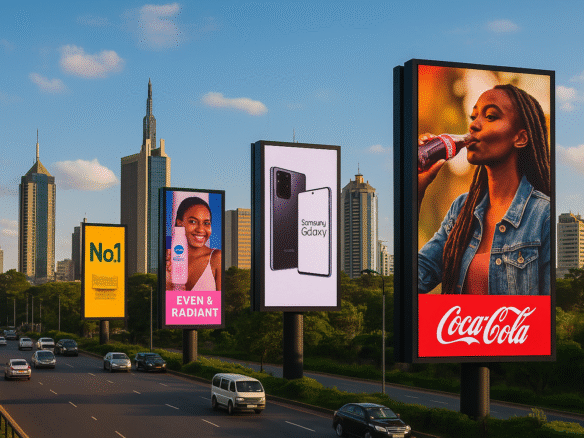
In Kenya, both static billboards and DOOH are growing. From major highways and busy urban roads in Nairobi, Mombasa, Kisumu, Eldoret, to transit hubs and airports, businesses are leveraging these formats to reach large, mobile, and diverse audiences.
Key Trends Driving OOH Advertising Growth
Integration of Digital & Interactive Technologies
Digital billboards, interactive screens, and LED video walls are becoming more common in Kenyan cities. Technologies like dynamic content (changing depending on time of day, weather, etc.), augmented reality (AR), and programmatic DOOH are opening up new possibilities. (landing.livead.co.ke)
Focus on Transit & Airport Advertising
Transit media—ads in buses, bus shelters, railway stations—and airport advertising are increasingly valuable. For example, Digital Mara Media captures large footfall in airports and transit hubs. (digitalmara.co.ke)
Hyperlocal & Personalized Messaging
Brands are localizing campaigns, using local languages, cultural touchpoints, community-specific content to resonate more deeply. This builds trust and improves recall. (landing.livead.co.ke)
Sustainability & Eco-Friendly Materials
Kenyan businesses, especially those with younger or environmentally conscious audiences, are paying attention to sustainable practices: solar-powered displays, recyclable materials, lower energy consumption etc. This not only improves brand perception but often aligns with regulatory or community expectations. (landing.livead.co.ke)
Data-Driven Planning & Metrics
Data (foot traffic, impression counts, demographics, mobile & GPS data), integrated with DOOH, enables advertisers to pick prime billboard locations, optimize timing, measure conversion & ROI. Campaigns are increasingly monitored in real-time. (digitalmara.co.ke)
Benefits of OOH Advertising for Kenyan Businesses
OOH advertising offers unique advantages that digital alone doesn’t fully capture. Here is why Kenyan advertisers should pay attention:
- High Reach & Visibility: Billboards on major roads, transit hubs, highways deliver exposure to thousands of commuters daily—both off-peak and peak.
- 24/7 Exposure: Static billboards work round the clock; digital ones can switch messages for different times of day.
- Brand Recall & Trust: Physical presence in urban landscape builds legitimacy—seeing a large billboard often signals a serious, established brand.
- Multi-Sensory Impact: Large formats, bright lights, creative visuals / motion on LED or video walls make a strong impact.
- Synergy with Digital & Social Media: OOH can drive online behaviour (check-ins, social media buzz), especially when location integrated, hashtags, QR codes etc.
- Local Market Penetration: For SMEs targeting neighbourhoods, towns, or specific routes, OOH delivers localized reach affordably.
Challenges & How to Overcome Them
High Initial Cost & Maintenance
Premium sites can be expensive; digital boards cost more in installation and power. To overcome: negotiate long-term contracts, target off-peak slots, share costs (e.g., co-advertisers), or seek sponsorship/ partnerships.
Regulatory & Permit Requirements
Local regulations in Nairobi, county governments, national highway authorities can impose restrictions. Ensure compliance with signage laws, local planning permissions. Hire professionals who know local procedure.
Ad Clutter & Message Fatigue
Too many ads dilute impact. The way around this is creative design, concise messaging, bold visuals, rotating content (for DOOH), and selecting less competitive but high visibility locations.
Measuring ROI & Attribution
Unlike digital marketing, attributing sales directly to a billboard may be fuzzy. Use campaign codes, QR codes, mobile tracking, surveys, and integrate with online analytics to get a clearer signal.
Best Practices: Creating Effective OOH Campaigns
Here are proven strategies to maximise success in the Kenyan market.
Location Is King
High-traffic highways, bus corridors, city entrances, transit stations, airports give high impressions. Map out your target audience’s movement: where do they commute, shop, pass?
Use Bold, Simple Messaging
Because viewers see billboards quickly (driving/walking), messages must be concise, visual, readable from a distance. One strong headline, eye-catching imagery, limited text.
Consistent Branding & Visual Identity
Use brand colours, fonts, logo placements consistently. For multi-billboard campaigns across locations, ensure coherence so people recognize you.
Time Your Campaigns Around Events & Seasons
Kenya has shopping seasons (Back to School, festive season), national holidays, sports events. OOH campaigns tied to these moments can deliver heightened impact.
Experiment with Digital DOOH & Dynamic Content
If budget permits, use digital/LED boards which allow for rotating content, localized messages, time-of-day switching (e.g. breakfast offers, traffic info). This increases relevancy and recall.
Integrate with Other Channels
Align OOH with radio, print, social media, online ads. For example, run a billboard campaign and promote it on Instagram/TikTok, using the same slogan; or use location-based mobile ads close to billboard sites.
Role of Data, Digital & Sustainability
These three pillars are shaping the future of OOH in Kenya.
- Data & Analytics: Audience measurement, reach estimation, demographic profiling. Kenya’s growth in mobile usage and data ecosystems enable better tracking.
- Digital Out-of-Home (DOOH): Dynamic messaging, interactivity, programmatic purchasing, real-time content. DOOH allows advertisers flexibility (e.g. changing ad content because of weather, traffic).
- Sustainability: Green materials, solar lighting, reducing waste in billboard production. Brands that lead on sustainability are likely to earn consumer goodwill and possibly regulatory incentives.
How KenyaBillboards.com and Other Major OOH Players Fit In
To succeed in OOH, local partnerships and knowing the ecosystem is vital. Here are some of the major players and how they contribute.
- KenyaBillboards.com — this platform offers insights into trends in Kenyan OOH marketing, current sites, high‐footfall locations, and helps advertisers make informed decisions. Their reports, like “OOH Marketing Trends in Kenya for 2025: What Advertisers Need to Know Now” are especially useful. (kenyabillboards.com)
- Digital Mara Media — leading transit, OOH and DOOH media company in Kenya. Exclusive advertising platforms at key airports, transit networks. (digitalmara.co.ke)
- Neo Media Ltd — known for digital LED billboards, interactive displays, video walls. Useful when you want cutting-edge or high-visibility digital formats. (neomedia.co.ke)
- Magnate Ventures, Alliance Media Kenya, Adsite Limited, Firmbridge Advertising — these are other well-established outdoor advertising companies offering static and digital billboards, bus shelters, street pole ads etc. (magnate-ventures.com)
Conclusion & Future Outlook
OOH advertising in Kenya is not fading — it’s transforming. As digital infrastructures improve, transportation networks grow, and urbanization continues, OOH and DOOH will become ever more central to brand awareness, local market dominance, and high reach.
Kenyan businesses that adopt data-driven strategies, embrace digital formats, focus on sustainability, and integrate OOH with other channels (online, offline) will be leading the pack in brand visibility and customer engagement.



Join The Discussion